By TXBayNews Staff
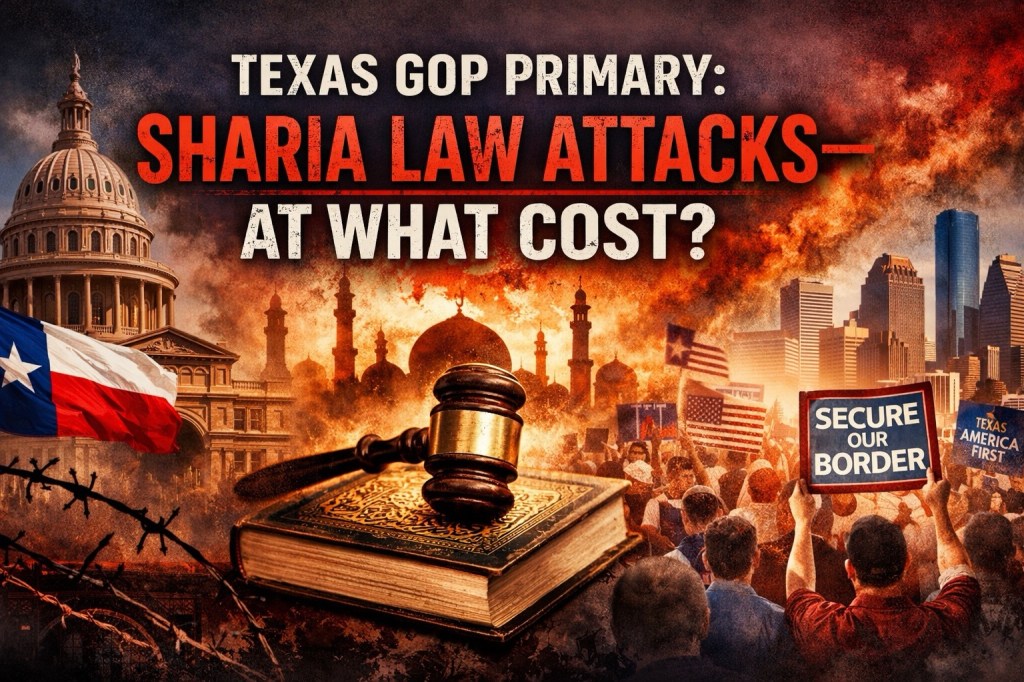
As Texas’ 2026 Republican primary heats up, a familiar culture-war tactic is back in force: warnings about “Sharia law.” According to a recent report by Politico, several Republican candidates are leaning hard into rhetoric that suggests Islamic law poses a creeping threat to Texas courts, schools, and public life.
For many conservative voters, the message is instantly recognizable—part border security, part national identity, part distrust of global ideologies. But as the primary field sharpens its elbows, the strategy raises an uncomfortable question for Texas Republicans: does this line of attack still advance conservative governance, or does it distract from the issues Texans say they care about most?
A Tried-and-True Primary Weapon
“Sharia law” attacks have surfaced in Texas politics for more than a decade, often during primaries when candidates need to differentiate themselves to a highly motivated base. The argument typically frames Islamic law as incompatible with American constitutional principles—especially individual liberty, equal protection, and separation of church and state.
In a low-turnout primary environment, the tactic can be effective. It signals ideological toughness, taps into post-9/11 anxieties, and draws a bright line between “us” and “them.” For challengers facing well-funded incumbents, it’s a quick way to grab headlines and social media oxygen.
The Problem: There’s No Policy There
Here’s the reality most Texans already know: Sharia law has no legal standing in Texas courts. State and federal constitutions explicitly bar religious law from overriding civil law, and Texas judges swear an oath to the U.S. and Texas constitutions—not to any religious text.
That leaves voters with a rhetorical fight over a problem that doesn’t actually exist.
Meanwhile, Texas faces real, concrete issues crying out for conservative solutions:
- Property taxes that keep climbing despite repeated promises of relief
- Border security challenges that remain unresolved
- Grid reliability concerns after multiple high-profile failures
- Cost-of-living pressures hitting working-class families across the state
Primary campaigns spent chasing symbolic threats are campaigns not spent debating how to govern Texas better.
A Risky Bet in a Changing Texas
Texas Republicans are right to take their primary electorate seriously. But Texas is also changing—demographically, economically, and culturally. Even many conservative voters are growing weary of attacks that sound more like cable-news talking points than governing priorities.
There’s also a strategic risk. Democrats and the media are quick to portray these attacks as evidence of intolerance, using them to energize their own base and alienate persuadable suburban voters. Whether fair or not, the optics matter—especially in statewide races where margins are tightening.
Conservatism Is Strongest When It Governs
Texas conservatism has historically won by emphasizing freedom, limited government, economic growth, and personal responsibility. Those principles don’t require invoking a foreign legal system that has zero chance of being implemented in Texas.
Primary voters deserve a serious debate about the future of the state—not a rerun of past culture-war scripts. If Republicans want to keep Texas red for the long term, they may need to prove they can do more than just sound alarms. They’ll need to show they can govern.
Bottom line: Attacking “Sharia law” may still fire up parts of the GOP base, but it risks turning a consequential Texas primary into a symbolic sideshow—at a moment when voters are demanding real answers to real problems.
 Texas Bay News
Leave a comment