By Michael Phillips | TXBayNews
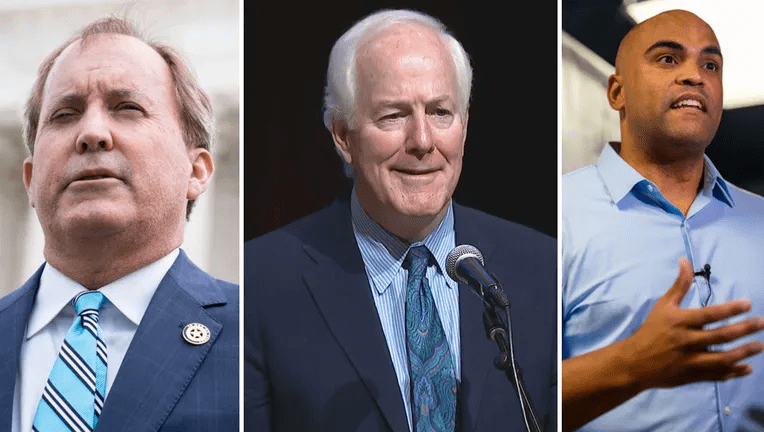
The 2026 U.S. Senate election in Texas is shaping up to be one of the most closely watched races in the country. The contest is for the Class II seat held by Republican John Cornyn, who has represented Texas since 2002 and is seeking a fifth term.
While Texas remains a Republican-leaning state, the March 3, 2026 primary is exposing deep ideological rifts inside the GOP—setting up a volatile race that could test turnout, party unity, and general-election strength.
Key Election Dates
- Voter registration deadline: February 2, 2026
- Early voting: February 17–27
- Primary Election: March 3, 2026
- Runoff (if needed): May 26, 2026
- General Election: November 3, 2026
With no candidate required to clear only a plurality threshold, a runoff between the top two finishers is widely expected.
Republican Primary: Cornyn vs. Paxton vs. Hunt
The Republican field is crowded, but the race has effectively become a three-way contest between establishment power, MAGA energy, and a next-generation conservative challenger.
John Cornyn (Incumbent)
- Senior U.S. senator, former NRSC chair
- Roughly $9 million raised with about $6 million cash-on-hand
- Backed by Senate leadership and major donors
- Campaign message: experience, electability, and legislative results
Cornyn is emphasizing his conservative voting record—including near-total alignment with Donald Trump’s judicial and policy priorities—while warning that nominating a controversial alternative could put a safe Republican seat at risk.
Ken Paxton (Texas Attorney General)
- Leading challenger and outspoken Trump ally
- Strong name recognition with the GOP base
- Approximately $3 million cash-on-hand
- Running hard against “Washington Republicans” on border security, guns, and foreign aid
Paxton’s message resonates with grassroots conservatives who see Cornyn as part of the GOP establishment. However, his legal history and impeachment saga give Democrats potential ammunition in the general election.
Wesley Hunt (U.S. Representative, TX-38)
- Army veteran and first-term congressman
- Positioned as a “clean” MAGA alternative
- Lower name recognition statewide
- Risks splitting the anti-Cornyn vote
Hunt has struggled to break out in polling but remains active in North Texas and conservative grassroots circles.
Other Republican Filers
The ballot includes a long list of lesser-known candidates, including business figures and first-time political entrants. None currently show measurable statewide support.
Center-Right Take
Paxton’s appeal with Trump-aligned voters is real, but Cornyn’s financial advantage and statewide infrastructure remain formidable. A runoff appears likely. The single biggest wildcard remains a possible Trump endorsement—which, as of mid-January, has not happened.
Democratic Primary: Crockett vs. Talarico
Democrats are hoping GOP infighting creates an opening, though history is not on their side. Texas has not elected a Democrat statewide since 1994.
Jasmine Crockett (U.S. Rep., TX-30)
- Progressive firebrand from Dallas
- Strong base enthusiasm and viral media presence
- Critics argue she may struggle with suburban and rural voters
James Talarico (State Rep., HD-50)
- Well-funded, younger candidate with strong social-media reach
- Emphasizes faith, bipartisanship tone, and policy detail
- Has raised more than $6 million, with a large cash reserve
Democrats consolidated the field after Rep. Colin Allred exited to pursue a House race, avoiding a damaging multi-candidate split.
Center-Right Take
Republicans privately see Crockett as the easier general-election opponent due to polarizing rhetoric. Talarico may present a more disciplined campaign, but the math remains difficult for Democrats statewide.
General Election Outlook
Nonpartisan race handicappers currently rate the contest Likely Republican, reflecting Texas’s R+6 partisan lean. Hypothetical polling shows Cornyn performing strongest in a general election matchup, while Paxton’s legal baggage could narrow margins in suburban areas.
Why This Race Matters Nationally
- Tests GOP identity: Trump-first populism vs. institutional conservatism
- Could affect Senate control in a closely divided chamber
- Early indicator of GOP primary voter priorities heading into 2028
Bottom Line
Texas Republicans face a strategic choice: renominate a seasoned incumbent with proven statewide appeal—or roll the dice on a base-energizing challenger with higher general-election risk. With early voting approaching and a runoff looming, turnout—not just ideology—may decide the outcome.
One thing is certain: the Texas Senate race will be one of the most expensive, divisive, and consequential contests of the 2026 cycle.
For official candidate lists and election updates, voters should consult the Texas Secretary of State, FEC filings, and the Texas Tribune’s ballot tracker.
 Texas Bay News
Leave a comment