By Michael Phillips | TXBayNews
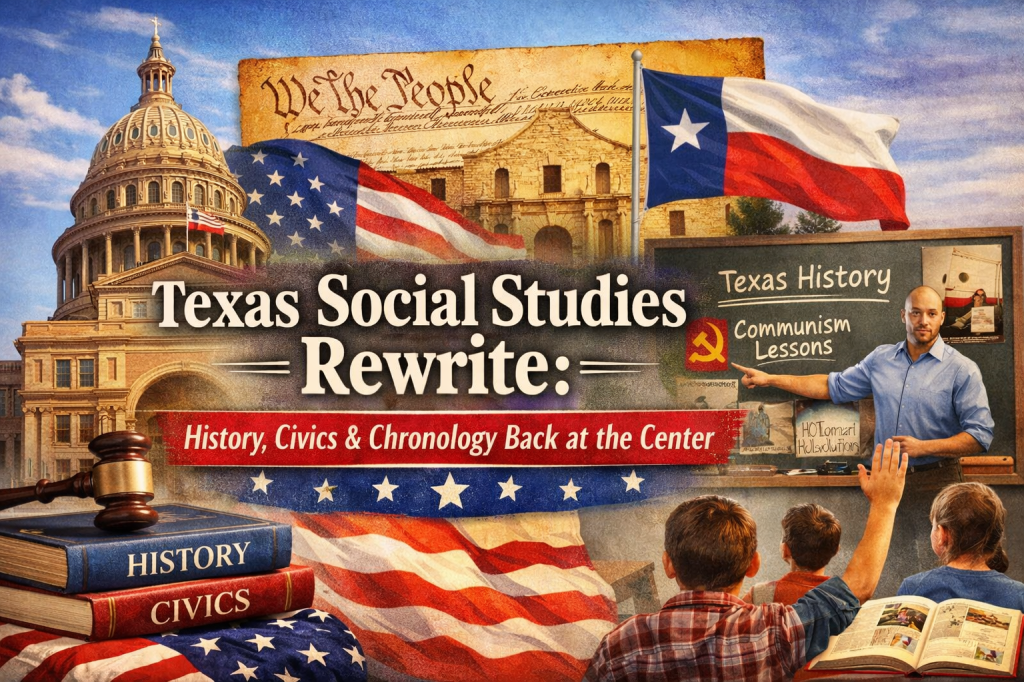
Texas is once again at the center of a national education debate as the state moves forward with a sweeping rewrite of its social studies curriculum, formally known as the Texas Essential Knowledge and Skills (TEKS). The process, outlined this week by the Houston Chronicle, reflects a broader struggle over how history, civics, and national identity should be taught to the next generation.
At stake is not just curriculum structure, but how Texas prepares students to understand their state, their country, and the world—at a time when civic knowledge is declining nationwide.
A Reset After Years of Controversy
The rewrite is being led by the elected Texas State Board of Education (SBOE), with technical support from the Texas Education Agency. A previous attempt in 2022 collapsed after conservative board members rejected drafts they argued leaned too heavily into ideology and cultural activism at the expense of foundational knowledge.
In September 2025, the board narrowly approved a new “comprehensive” framework by an 8–7 vote. The revised structure shifts away from thematic or skills-based models and back toward a chronological approach emphasizing Texas and U.S. history—an approach long favored by education reformers concerned about fragmented learning.
Under the new framework:
- Grade 3 begins with the foundations of Western civilization.
- U.S. and Texas history receive heavier emphasis in middle grades.
- Grade 8 becomes a dedicated Texas history capstone.
- Standalone world cultures and geography courses are reduced or integrated rather than taught in isolation.
Draft standards are expected in early 2026, with final approval targeted for summer 2026. Full implementation would not reach classrooms until around 2030, reflecting the long lead time required for textbooks, teacher training, and standardized testing updates.
Why Supporters Say the Changes Are Needed
Center-right education advocates argue the rewrite is a corrective response to years of declining civic literacy. National Assessment of Educational Progress (NAEP) data show eighth-grade U.S. history proficiency has fallen to levels not seen since the 1990s, a trend mirrored in Texas.
Supporters contend that students cannot analyze history critically if they lack a clear factual and chronological foundation. From this perspective, the revised TEKS are less about politics and more about restoring coherence, rigor, and shared civic knowledge.
They also argue that Texas has a legitimate interest in ensuring students understand the principles that shaped the state and nation—constitutional government, individual liberty, free enterprise, and the rule of law—before moving into more complex global comparisons.
The Communism Education Mandate
Overlaying the broader rewrite is a separate legislative requirement passed in 2025. Senate Bill 24 mandates instruction on the atrocities and tactics of communist regimes for students in grades 4–12, with accelerated implementation by the 2026–2027 school year.
The law, championed by Lt. Gov. Dan Patrick, requires age-appropriate lessons on events such as the Holodomor, the Cultural Revolution, the Cambodian genocide, and communist movements in Latin America and Cuba. The goal, supporters say, is to ensure students understand the human cost of collectivist systems and can contrast them with American democratic principles.
While critics argue the mandate is one-sided because it does not also require instruction on fascism or Nazism, proponents note that those topics are already extensively covered in existing curricula. They view the law as a response to polling that shows growing openness to socialism among younger Americans, rather than a Cold War throwback.
Concerns From Critics—and an Ongoing Process
Opposition voices, including some historians and progressive advocacy groups, warn the framework may delay exposure to non-Western histories and diverse perspectives. They also object to the appointment of conservative content advisors, arguing the panel lacks sufficient classroom experience.
SBOE members backing the rewrite counter that public input remains open, teachers are involved in drafting, and no final standards have been released. They emphasize that the process is iterative—and that claims of “whitewashing” are premature until the actual lesson requirements are published.
A Broader Question About Education’s Purpose
Ultimately, the Texas TEKS debate reflects a deeper national question: Should social studies primarily cultivate identity and social critique, or should it first ensure students know their history well enough to evaluate it honestly?
Texas appears poised to answer by doubling down on chronology, civics, and state history—betting that a content-rich approach will better prepare students for informed citizenship. Whether that bet pays off will depend not on headlines, but on how the final standards are written and how well they are taught.
For now, the rewrite remains unfinished—but its direction is clear.
 Texas Bay News
Leave a comment