And Texas Families Should Pay Attention.
By Michael Phillips | TXBayNews
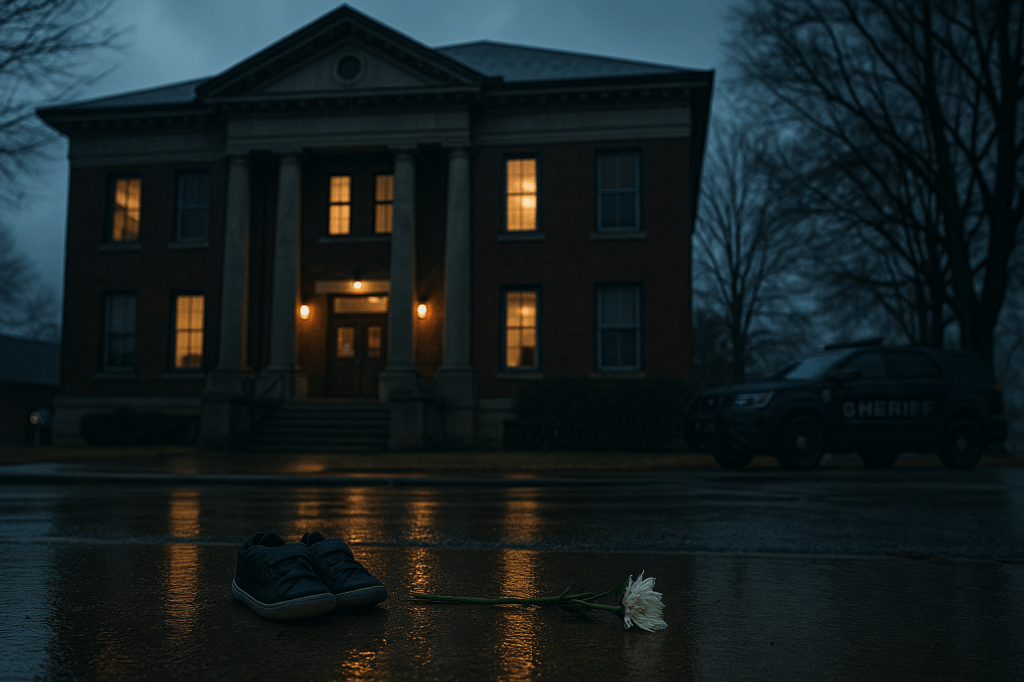
On Wednesday, December 3, 2025, deputies in Sebastian County, Arkansas, went to a stately home on South 1st Avenue in the small town of Bonanza for a welfare check.
Inside, they found 40-year-old Charity Powell-Beallis and her 6-year-old twins dead from gunshot wounds.
Just one day earlier, Charity had attended what was supposed to be her final divorce hearing with her estranged husband, Dr. Randall “Randy” Beallis, a local physician arrested earlier that year for strangling her in front of their children.
This wasn’t a random crime. It followed a long trail of warnings—many made by Charity herself.
From Strangulation to Suspended Sentence
A Case That Never Should Have Slipped Through the Cracks
The timeline is chilling:
- February 16, 2025 – Charity calls 911. Deputies document injuries consistent with strangulation. The twins were present, watching. Randy is arrested and charged with aggravated assault on a family member, third-degree domestic battery, and two counts of endangering the welfare of a minor.
- March 5, 2025 – Charity files for divorce. She seeks a protective order, full custody, and possession of the home.
- October 9, 2025 – Prosecutors accept a plea deal. All major charges are reduced to misdemeanor third-degree battery. Randy receives a one-year suspended sentence, a fine, and must attend a domestic-violence program. A no-contact order is entered—except for court-approved visitation.
- December 2, 2025 – Charity and Randy appear for a final divorce hearing. Family members say the discussion included a joint-custody arrangement. Court records confirm the hearing was held, but no final written order has yet been posted online. What is clear: Charity left devastated, feeling less protected—not more.
Less than 24 hours later, she and the twins were gone.
As of this writing, no one has been arrested. Investigators have not publicly named a suspect. Randy’s attorney says his client is cooperating and denies involvement. Under American law, he is presumed innocent unless and until proven guilty.
But Charity’s family members—particularly her father and her adult son, John—say they believe Randy is responsible. They cite “financial gain and hatred” as possible motives. Those are allegations, not findings. But they reflect the anguish of a family that watched Charity beg the courts for help.
“Lives Are at Stake, Including the Lives of Young Children.”
Charity Saw This Coming
In August 2025, months before the murders, Charity commented publicly on a local station’s domestic-violence story:
“I am the victim, yet I’ve been treated like the problem while the criminal — a local doctor — is being shielded by the very system that’s supposed to protect us. I’ve tried to reach Prosecuting Attorney Daniel Shue, but he won’t even accept a letter from me… My voice, as the victim, has been shut out. Lives are at stake, including the lives of young children.”
Earlier in the year, she told State Senator Terry Rice she feared for her life and her children’s safety. Rice connected her with state resources, including the Arkansas State Police Crimes Against Children Division. Still, nothing in the system changed the trajectory of her case.
Charity did everything society tells victims to do:
- Report the violence
- Seek a protective order
- File for divorce
- Request full custody
- Notify a prosecutor
- Notify a state lawmaker
- Document her fears in writing
And yet the end result was the same tragic pattern seen all over the country: a victim sounding the alarm while the system hits the mute button.
What Investigators Have—and Haven’t—Said
A Tightly Controlled Triple-Homicide Probe
The Sebastian County Sheriff’s Office has confirmed:
- The deaths are homicides, not a murder-suicide.
- At least six search warrants have been executed, with more pending.
- Multiple agencies are assisting, including Arkansas State Police, local departments, the U.S. Secret Service, and Homeland Security Investigations (HSI).
Federal agencies typically join local investigations when:
- Financial records or asset tracing are relevant
- Interstate digital evidence is involved
- A suspect has professional ties requiring specialized forensic review
Officials have not publicly explained their involvement. But it is unusual—and suggests investigators are exploring more than just a physical crime scene.
One detail added to the family’s outrage:
- On December 4—the day after the murders—Randy’s attorney moved to dismiss the divorce case, citing Charity’s death. Under Arkansas law, this could revert certain marital-property questions, including possession of the home.
- On December 7, John Powell, Charity’s adult son, filed a counter-motion to protect his mother’s estate.
Again, none of this proves motive. But it underscores why the family feels Charity’s warnings were ignored in life—and are at risk of being ignored in death.
The Broader Pattern
Why This Arkansas Case Should Alarm Texas Families
If you remove the names and state lines, this case looks painfully familiar to anyone who has followed domestic-violence homicide patterns:
- A professional man with standing—doctor, officer, business owner.
- A documented strangulation assault, one of the clearest predictors of future homicide.
- A plea deal that reduces serious conduct to a misdemeanor.
- A mother seeking full custody who leaves court believing she must now share her children with the man she says abused her.
- A judicial system that treats domestic violence as background noise rather than a flashing red warning sign.
- A violent outcome shortly after separation—the statistically most dangerous time for victims.
This isn’t just an Arkansas problem. It’s a Texas problem.
Texas Domestic-Violence Homicides: A Trend Texans Must Not Ignore
The Texas Council on Family Violence reports:
- 205 Texans were killed by intimate partners in 2023, nearly double the number from a decade ago.
- In 2024, the number declined to 161, the first significant drop in years—progress advocates call hopeful but fragile.
- Harris County, however, saw a 34% spike in domestic-violence homicides even as the statewide number fell.
- Separation, strangulation, and firearm access remain the top risk factors—all present in Charity’s case.
In other words: what happened in Bonanza follows the same contours as what is killing Texans.
Family Courts Are Often the Weakest Link
Texas judges, like many nationwide, are not required to treat a history of domestic violence as disqualifying in custody determinations. Many survivors report that abuse is treated as “parent-to-parent conflict” rather than a sign of danger to children.
Joint custody is too often treated as the “neutral” solution, even when one parent is afraid for their life.
Charity’s case is a tragic reminder that “splitting the difference” in court can be deadly outside of it.
Five Questions Texans Should Be Asking Now
- How are strangulation cases handled in my county?
- Are prosecutors reducing them to misdemeanors even when children witness the assault?
- Does domestic violence meaningfully influence custody decisions here?
- Or is it routinely minimized as noise in a high-conflict divorce?
- What happens to firearms when a protective order is issued?
- Texas does not have a uniform statewide process for actually removing weapons once an order is entered.
- Are victim complaints to prosecutors documented and escalated?
- In Charity’s case, a letter saying “Lives are at stake” reportedly went unanswered.
- Are marital assets automatically frozen when a spouse dies under suspicious circumstances?
- Many states, including Texas, lack consistent safeguards to prevent a potential suspect from immediately benefiting.
These are not theoretical questions. They are the exact points at which Charity’s case fell apart.
If You’re in Danger—or Trying to Help Someone Who Is
You cannot rely on the system alone. You should not have to—but Charity’s case shows the risks of assuming the courts will intervene in time.
Here are concrete steps for Texans:
- Document everything: texts, injuries, threats, police reports, social-media posts.
- Tell more than one authority: local police, sheriff, and if needed, a state lawmaker.
- Seek specialized advocacy: shelters, legal aid, and crisis centers know how to navigate the parts of the system victims don’t see.
If You Need Help in Texas
National Domestic Violence Hotline
1-800-799-SAFE (7233) | thehotline.org
Texas Advocacy Project
Free civil legal services
texasadvocacyproject.org
Texas Council on Family Violence
Statewide shelter & resource locator
tcfv.org
If you believe you or your children are in immediate danger, call 911 and request an officer trained in domestic-violence response.
The Lesson for Texas
Charity Powell-Beallis spent the final year of her life begging the system to hear her.
She was clear. She was specific. She followed every step she was supposed to follow.
And still, she and her children died.
The question for Texas is simple:
Will we treat this as a distant Arkansas tragedy—
or as a warning about everything we could fix before the next Charity tries to save her children and can’t?
 Texas Bay News
Leave a comment