By Michael Phillips | TXBayNews
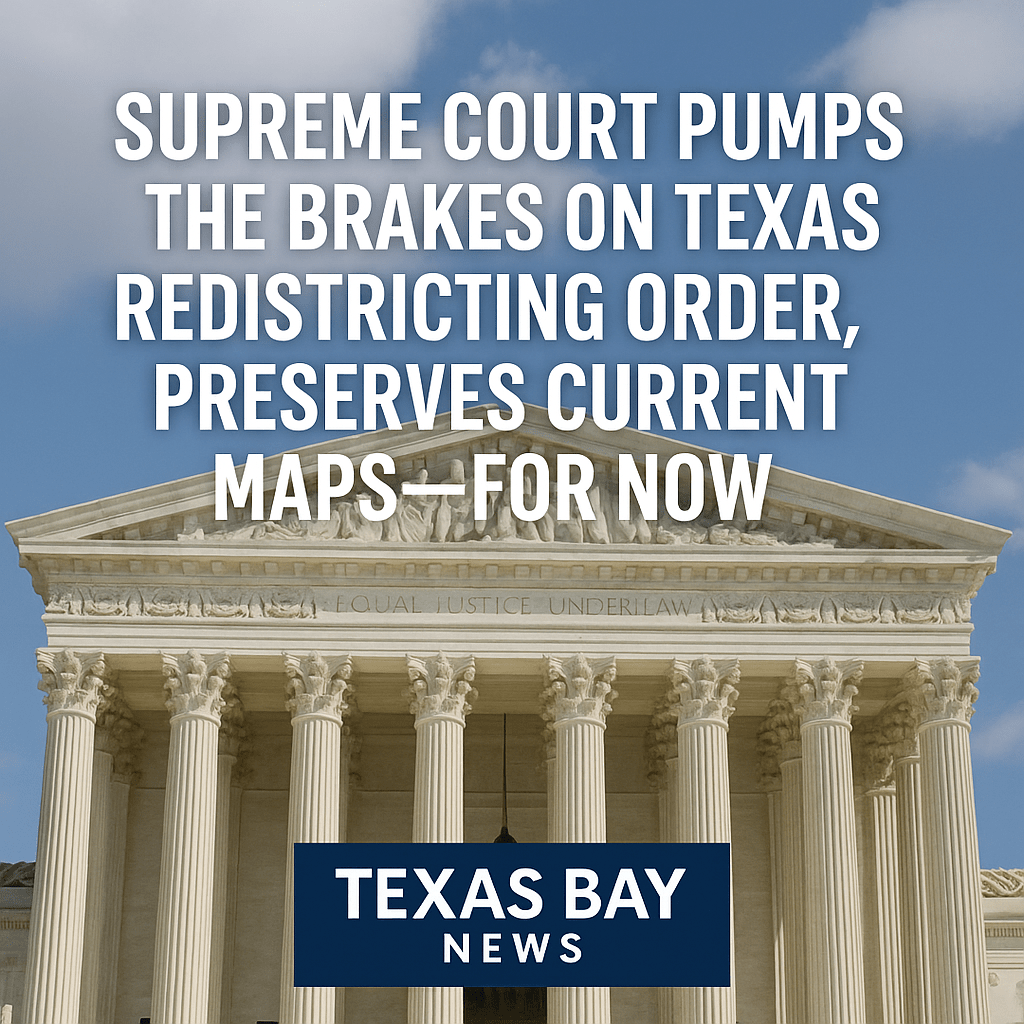
In a move that immediately shifted the political landscape in Texas, the U.S. Supreme Court on Monday extended an administrative stay that temporarily blocks a lower-court ruling forcing the state to redraw two House districts in the Dallas–Fort Worth region.
The order means one thing: Texas’ current congressional map stays in place—at least until the Court decides whether to fully intervene.
The dispute centers on House Districts 6 and 33, where a three-judge federal panel claimed the Republican-drawn boundaries diluted Black and Hispanic voting strength in violation of the Voting Rights Act. Texas Attorney General Ken Paxton appealed, arguing the ruling ignored key Supreme Court precedent and attempted to rewrite the state’s political map months before the 2026 election cycle begins in earnest.
By granting the stay, the Supreme Court signaled—again—that federal courts should be extremely cautious about forcing states to redraw maps on short timelines, especially based on racial-gerrymandering claims the Court has increasingly treated with skepticism.
A Familiar Pattern: Lower Courts Push, Supreme Court Pulls Back
This case follows a growing trend:
- Lower federal courts increasingly attempt to reshape state political maps.
- States appeal.
- The Supreme Court steps in to pause or reverse the decisions.
Conservatives argue this pattern reflects an overdue correction to the judiciary’s decades-long involvement in political mapmaking—an area the Constitution largely leaves to state legislatures, not federal judges.
In Rucho v. Common Cause (2019), the Court declared that partisan gerrymandering claims fall outside federal court jurisdiction. Yet activists and lower courts have tried to repackage partisan fights as racial disputes to pull the judiciary back into the process. Texas officials say this case is the latest example.
Texas’ Argument: The Lower Court Ignored the Law
Texas contends the panel:
- Misapplied Section 2 of the Voting Rights Act, which prohibits discriminatory voting practices but does not guarantee proportional representation for any racial group.
- Undoing districts now would violate the Court’s own Purcell Principle, which warns against late judicial changes close to an election.
- Relied on demographic inferences rather than actual evidence that minority voters are being denied the ability to elect their preferred candidates.
Texas lawmakers maintain that the districts reflect partisan considerations—a legally permissible basis—not racial discrimination.
Why Conservatives See This as a Test Case
For right-of-center observers, the case raises a big question:
Should courts be allowed to second-guess the political judgments of state legislatures every election cycle?
Many argue that activist litigation has turned redistricting into a never-ending process—one where maps are never settled and judges hold disproportionate power over elections.
With Texas adding millions of new residents and gaining political influence nationally, attempts to force repeated redraws are seen by Republicans as a political strategy disguised as civil-rights enforcement.
If the Supreme Court ultimately takes the case—and the extension of the stay suggests it may—conservatives hope it will further clarify (or restrict) how far courts can go in policing racial claims in redistricting.
Looking Ahead: 2026 Is Getting Closer
Candidates begin filing next year for the 2026 midterms. Any redistricting upheaval this late could throw campaigns into chaos, reshape voter coalitions, and potentially flip races Democrats have been targeting for years.
By keeping the current maps intact for now, the Supreme Court has preserved stability—but also set up a potentially major decision about the future of the Voting Rights Act, racial claims, and the balance of power between state legislatures and federal courts.
One thing is clear:
Texas isn’t just a battleground for elections. It’s a battleground for who gets to write the rules.
 Texas Bay News
Leave a comment